I’ve noticed a disturbing trend in modern kitchens. We buy tools to save time, but end up spending all our time digging through drawers just to find a spatula that doesn’t bend like wet cardboard. Here’s the ugly truth: your kitchen drawer isn’t a storage space. It’s a graveyard for single-use gadgets you bought at 2 AM after watching an infomercial.
Trust me on this—that avocado slicer, the banana hanger, and the motorized garlic peeler are not sparking joy. They are taking up prime real estate. If you are tired of wrestling your utensil drawer every time you try to flip a pancake, pull up a chair. I’m going to walk you through my battle-tested, ruthless step-by-step guide to clearing out the culinary clutter once and for all.

Key Takeaways & Quick Overview
AI Verified
- ✔I’ve noticed a disturbing trend in modern kitchens.
- ✔We buy tools to save time, but end up spending all our time digging through drawers just to find a spatula that doesn’t bend like wet cardboard.
- ✔Here’s the ugly truth: your kitchen drawer isn’t a storage space.
- ✔It’s a graveyard for single-use gadgets you bought at 2 am after watching an infomercial.
The “Total Extraction” Protocol: Emptying the Drawer of Truth
You can’t fix a mess by rearranging it. I see people do this every day. They buy little plastic bins, put them inside the messy drawer, and shove the same garbage back into smaller compartments. Stop doing that.
Step one is violent transparency. Pull every single utensil out of every drawer, crock, and hanging rack in your kitchen. Put them on the dining table or the floor. Don’t sort yet. Just get them out of their hiding spots. When you see the sheer volume of stainless steel and silicone spread out before you, the psychological shift happens instantly. You realize you own fourteen wooden spoons. Why? Nobody knows. You aren’t running a soup kitchen for an army.
Once everything is exposed to the harsh light of day, grab a damp cloth and wipe out the bottom of that drawer. You’ll probably find crumbs from 2021. Let that disgust fuel the sorting process.
The Three-Pile Filter: Keep, Donate, and the “Purgatory Box”
Now comes the hard part. Decision fatigue is real, which is why we keep it simple. You are going to sort every item into three distinct piles: Keep, Donate, and Trash (or recycle, depending on the material). But wait—let’s talk about the psychological safety net known as the Purgatory Box.
If you have item anxiety, grab a cardboard moving box. When you can’t decide if you’ll ever use that micro-zester again, toss it in the box. Seal it up, write the date six months from today on the lid, and shove it in the basement or garage. If you don’t open that box once in the next six months to retrieve a specific tool, you didn’t need it. Donate the whole box without looking inside. It’s a cheat code for sentimental hoarders.
As you sort, run every item past this strict filter:
- Frequency: Have I used this in the last 90 days? (Be honest with yourself).
- Multi-functionality: Does this tool do only one job? If it peels kiwi and nothing else, it’s gone.
- Condition check: Is the plastic melted? Is the wood cracked and harboring bacteria according to FDA kitchen safety guidelines? Toss it.
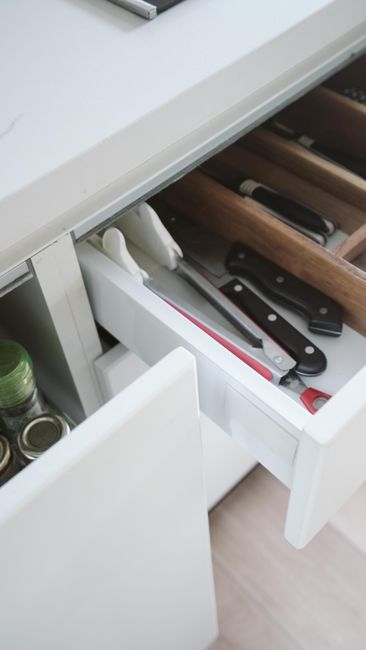
Killing Off the Single-Use Gadgets Once and for All
Manufacturers love selling you solutions to problems that don’t exist. They rely on the fact that we are inherently lazy and believe a special tool will make us better cooks. It won’t. Skill comes from repetition, not a strawberry huller.
Let’s look at the usual suspects that need to leave your kitchen immediately:
- The Egg Slicer: A knife exists. Use it.
- The Cherry Pitter: Unless you are running an artisanal jam operation out of your garage, spit the pits out or use a straw.
- Slap-Choppers and Garlic Rollers: If it has moving parts that require you to read a manual, it has no business in a functional workspace.
- Dull Metal Peelers: If it tears a tomato instead of peeling a carrot, throw it away. Buy a sturdy, professional-grade Y-peeler and never look back.
When you eliminate the single-purpose junk, you make room for workhorses. You only need a few core items to conquer 95% of cooking tasks: a reliable chef’s knife, a flexible fish spatula, a sturdy pair of stainless steel tongs, a silicone scraper, and a heavy wooden spoon. Everything else is mostly noise.
The Maintenance Rule: One In, One Out
You’ve done the hard work. Your drawers close smoothly. You can actually find the whisk without bleeding. Now, how do you keep it that way?
Adopt the One In, One Out policy. If you buy a new slotted spoon, an old slotted spoon must leave the ecosystem. No exceptions. This creates a natural bottleneck against impulse purchases at home goods stores. Furthermore, do a quarterly sweep. Every three seasons, open the drawers and pull out anything that migrated to the back.
Kitchens should be efficient laboratories, not museums of discarded consumerism. Clear out the clutter, respect your workspace, and watch how much more enjoyable cooking becomes when your tools actually work for you.
Frequently Asked Questions
How do I get rid of old metal and plastic utensils responsibly?
Metal utensils, such as stainless steel tongs or whisks, can usually be recycled at local scrap metal facilities. Plastic utensils generally cannot be recycled in curbside bins, so look for local hard-plastic recycling programs or repurpose them for non-food tasks like gardening or kids’ crafts.
What should I do with inherited kitchen utensils I never use?
If they carry deep sentimental value, pick one or two centerpiece items (like a grandmother’s wooden spoon) to display in a crock on the counter. Donate or sell the rest. Kitchen tools were built to be used, not kept captive in a dark drawer out of guilt.
How many spatulas and spoons do I actually need?
For a standard household, two good wooden spoons, two silicone spatulas of varying sizes, one metal turner, and one slotted spoon are more than enough. If you cook large family meals daily, you can double that count, but anything beyond ten total stirring tools is excessive.
Are silicone utensils safer than plastic or wood?
High-grade silicone is heat-resistant, non-porous, and gentle on non-stick pans, making it a safer option than cheap melting plastics. Always check that your silicone tools meet strict material safety standards to ensure they are food-grade and free of chemical fillers.